
Supplements
Magnesium: the types on the shelf and how they differ
Magnesium is always paired with something else in a supplement — citrate, glycinate, oxide, malate — and that partner changes the tablet size, how it is tolerated and how much elemental magnesium you actually get per serving.
- Written by
 Jack· BIOVEA Wellness Advisor
- Published
- July 30, 2026
- Last reviewed
- September 10, 2026
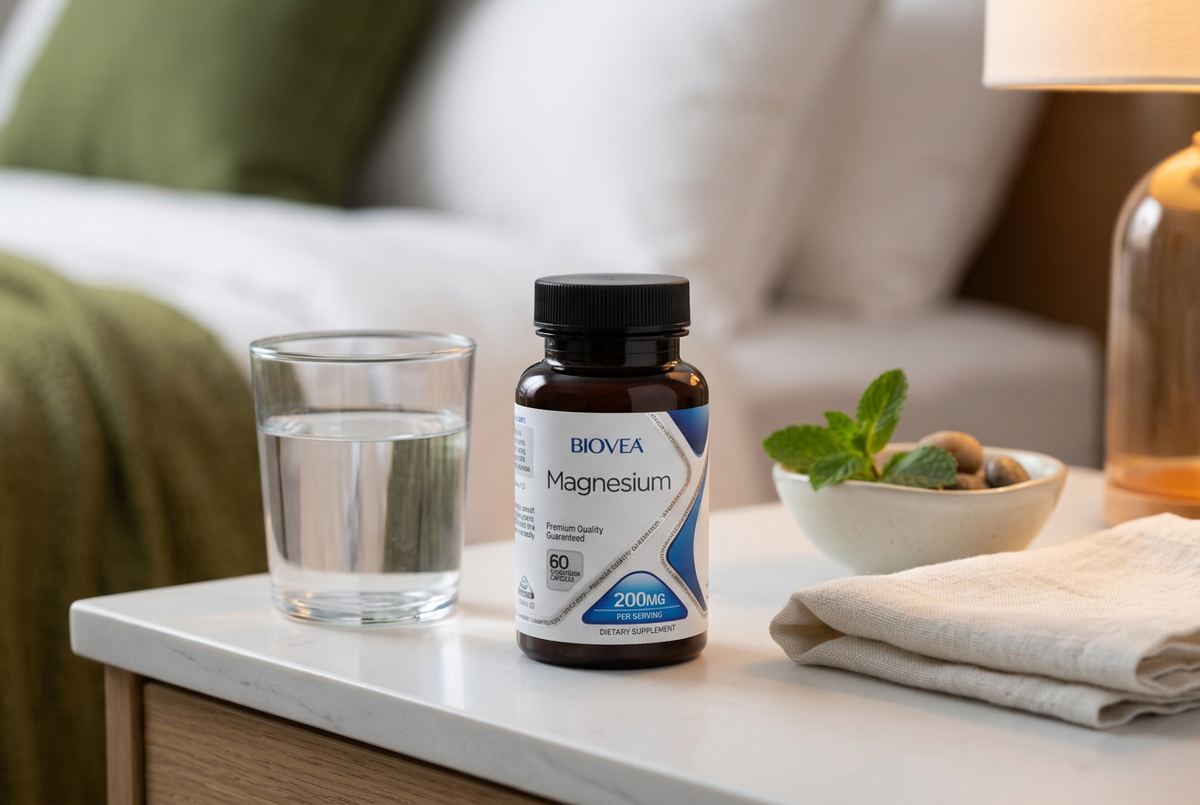
Walk along a supplement shelf and magnesium appears half a dozen times with a different second word each time. Those second words are not marketing: magnesium is a reactive metal, so it is always supplied bound to something — an acid, an amino acid, or oxygen. That partner determines the size of the tablet, how the product tends to be tolerated, and crucially how much actual magnesium is in a serving.
Start with the elemental figure
The number that matters is elemental magnesium — the magnesium itself, not the weight of the whole compound. A capsule containing 500 mg of magnesium citrate does not contain 500 mg of magnesium; the citrate makes up most of that weight. Well-written labels state it plainly, for example 'magnesium citrate 1500 mg, providing 240 mg magnesium'.
If a label only shows the compound weight, you cannot compare it fairly with a label that shows elemental content. In the EU and UK the elemental figure and the %NRV must appear; in North America the Supplement Facts panel shows magnesium with a %DV. Either way, that is the line to read.
The forms you will see
The list below is descriptive, not a ranking. Different forms suit different people, and the most common reason someone switches is digestive comfort rather than any dramatic difference in outcome.
| Form | Bound to | Commonly noted for |
|---|---|---|
| Citrate | Citric acid | Widely used, dissolves readily, often in powders and drinks |
| Glycinate (bisglycinate) | The amino acid glycine | Gentle reputation; tablets tend to be larger |
| Oxide | Oxygen | High magnesium by weight, so smaller tablets; less well absorbed |
| Malate | Malic acid | Common in powders and fitness-oriented formulas |
| Chloride | Chloride | Used in drops and topical products as well as capsules |
| L-threonate | Threonic acid | A newer, more expensive form found in premium formulas |
Magnesium oxide is a useful example of why the elemental figure matters in both directions. It carries a high proportion of magnesium by weight, which keeps tablets small, but a smaller share of it is absorbed than from forms such as citrate or glycinate. Neither fact alone makes it the right or wrong choice — it depends on the dose, the format and how it sits with you.
Food first, as usual
Magnesium is widespread in food: pumpkin seeds, almonds, cashews, dark leafy greens, legumes, wholegrains and dark chocolate all contribute. Most national guidance treats a varied diet as the starting point and supplements as a way of closing a gap, not a replacement for the list above.
- Read the elemental magnesium per serving, not the compound weight.
- Note how many capsules make up that serving.
- Powders let you divide a dose; capsules are easier to travel with.
- If a product does not agree with you, a different form is often the simplest change.
Sensible cautions
Magnesium supplements can interact with certain medicines, including some antibiotics, and intakes above published upper limits can cause digestive upset. Anyone with reduced kidney function, or who is pregnant, breastfeeding or taking prescription medicines, should ask a pharmacist or doctor before starting. This article is educational and is not a substitute for that conversation.
The bottom line
There is no single best magnesium. Compare on elemental content, pick a form and format you can keep taking comfortably, and keep the rest of your diet in the picture. If you are choosing between two products that look identical, the label — not the front of the box — will tell you which is which.
Frequently asked questions
- Which magnesium form is best absorbed?
- Organic salts such as citrate and glycinate are generally better absorbed than oxide, but absorption is only one factor alongside dose, format and personal tolerance.
- Why is 500 mg of magnesium citrate not 500 mg of magnesium?
- The 500 mg is the whole compound. The citrate part accounts for most of that weight, so the elemental magnesium is far lower — the label should state it.
- Morning or evening?
- There is no universal rule. Follow your product's directions and pick a time you will remember consistently.
Sources
Jack used these official and scientific sources for this article.
This article is educational. Food supplements are not a substitute for a varied diet or medical care. Speak to a healthcare professional about your own situation.
Related reading
Vitamins
Vitamin D: forms, intake and the questions people actually ask
Vitamin D is made in the skin from sunlight and also comes from a short list of foods and supplements. Most labels offer either D2 or D3, measured in micrograms (mcg) or International Units (IU) — and for many people the real question is not which brand, but how much they already get.
9 min read
Read more
Ingredient Guides
Understanding supplement labels and serving sizes
Almost every confusing supplement comparison comes down to three lines on the pack: the serving size, the amount per serving, and the reference percentage next to it. Learn those and the shelf gets much quieter.
6 min read
Read more
Vitamins
How to choose a multivitamin without guessing
A multivitamin is a convenience product: a spread of nutrients at modest amounts. Choosing one sensibly means matching the formula to the gaps in your own diet and life stage, then reading the panel rather than the front of the box.
7 min read
Read moreCountry & language
3 published versions of this article.
- Canada — EN
- Canada — FR
- USA — EN
- Belgique / België — FR
- Cyprus — EN
- Deutschland — DE
- Finland — EN
- France — FR
- Hungary — EN
- Ireland — EN
- Österreich — DE
- Rest of Europe — EN
- Romania — EN
- Slovenia — EN
- Sweden — EN
- Schweiz / Suisse / Svizzera — DE
- Schweiz / Suisse / Svizzera — FR
- UK — EN
- Australia — EN
- Hong Kong — EN
- India — EN
- Israel — EN
- Malaysia — EN
- New Zealand — EN
- Qatar — EN
- Republic of Korea — EN
- Singapore — EN
- Thailand — EN